

Two Weeks' Rent in Advance: What It Means and Why It Matters in Queensland
If you've ever signed a lease or managed a rental property in Queensland, you've almost certainly come across the term "two weeks' rent in advance." It comes up at the start of nearly every tenancy, yet it's one of those things that sounds straightforward but still manages to confuse people on both sides of the lease agreement.
Whether you're a landlord trying to understand what protections are in place, or a tenant figuring out what you need to pay before you get your keys, this one's worth understanding properly. Let's break it down simply.
What Does "Two Weeks' Rent in Advance" Actually Mean?
In Queensland, two weeks' rent in advance is the maximum amount of rent a landlord can ask a tenant to pay upfront at the start of a tenancy. It's set out under the Residential Tenancies and Rooming Accommodation Act 2008 and applies to the vast majority of standard residential tenancies across the state.
Essentially, before a tenant moves in, they pay their first two weeks of rent ahead of time. From that point forward, rent is paid in a cycle that keeps them two weeks ahead of where they're actually living.
It's not a deposit, it's not a bond, and it's not a holding fee. It's simply the first rent payment, collected upfront.
How Is Paying in Advance Different from Paying in Arrears?
This is where a lot of confusion creeps in, and it's a fair question. Here's the difference in plain terms.
Paying in advance means you pay before you receive the benefit. A tenant who pays two weeks' rent in advance on day one is paying for the first two weeks of occupancy before they've lived in the property.
Paying in arrears means you pay after receiving the benefit. Like a postpaid phone bill, you use the service first and pay afterward.
Most residential leases in Queensland are structured so tenants pay in advance. This means at any point during a tenancy, the tenant's rent payments are sitting ahead of where they are in time. If a tenant is up to date with rent, they should always have at least two weeks already paid ahead.
This is why, during an exit from a tenancy, a tenant who has kept up with payments won't owe any additional rent right up to their last day. The advance payments carry them to the end.
Is Two Weeks' Rent in Advance a Legal Requirement in Queensland?
Under Queensland law, a landlord cannot ask for more than two weeks' rent in advance for a periodic or fixed-term tenancy. Asking for three or four weeks upfront isn't permitted, regardless of the landlord's preference or any special circumstances.
The Residential Tenancies Authority outlines these rules clearly, and it's one of those areas where the legislation doesn't leave much room for negotiation. The RTA's guidance on rent payments is a solid reference for both landlords and tenants who want to dig into the specifics.
There are some exceptions for particular accommodation types, but for the standard residential tenancies we deal with across Mackay, Sarina and Nebo every day, the two-week rule applies.
How Does This Relate to the Bond?
Two weeks' rent in advance and the rental bond are two completely separate payments, and it's important not to mix them up.
The bond is a security deposit, typically equal to four weeks' rent, that is lodged with the RTA and held for the duration of the tenancy. It exists to cover potential costs at the end of the tenancy, such as unpaid rent, cleaning, or property damage beyond fair wear and tear.
The two weeks' rent in advance is simply the first rent payment. It's not held by the RTA. It's paid directly to the landlord or property manager as the first instalment of rent.
At the start of a tenancy, a tenant may be asked to pay both. That means the upfront costs at the beginning of a Queensland tenancy can include:
- Up to four weeks' bond (lodged with the RTA)
- Two weeks' rent in advance (paid to the landlord or property manager)
- Any applicable holding deposit, if one was collected earlier (often offset against the above)
Knowing the difference between these payments helps avoid disputes down the track.
Common Misconceptions Landlords and Tenants Get Wrong
We deal with questions around this topic regularly, and a few misunderstandings come up more than others.
Can a landlord hold the advance rent as extra security?
No. The two weeks' rent in advance is rent, not a deposit. It must be treated as rent and applied to the tenancy accordingly. It cannot be held separately as additional security over and above the bond.
Can a tenant use their advance rent to cover their last weeks?
This is one of the most common misconceptions. A tenant should never stop paying rent in the final weeks of a tenancy on the assumption that their advance rent will cover it. The advance rent is already spent. It was applied to the first weeks of the tenancy. Continuing to pay rent right up until the end of the lease is the tenant's responsibility. Landlords, this is worth flagging early in a tenancy to avoid confusion later.
Does the two weeks' rent in advance earn interest?
No. Unlike some bond arrangements in other states, the rent paid in advance in Queensland does not accumulate interest that is owed back to the tenant.
What This Means for Landlords and Investors
If you own a rental property in Central Queensland, understanding how rent in advance works gives you a clearer picture of your cash flow from day one.
At the start of a tenancy, you'll receive two weeks' rent before your tenant even turns the key. That means your rental income cycle is always running ahead, which provides a small but useful buffer when it comes to monitoring arrears.
From a property management perspective, if a tenant's payments fall behind by two weeks, they've effectively caught up to real-time. Any further non-payment beyond that point means they are genuinely behind on their obligations. Having a property manager who monitors this closely, and acts early, makes a real difference.
We track arrears regularly across our managed properties in Mackay, Sarina and Nebo, because early intervention is almost always more effective than chasing larger debts later.
Frequently Asked Questions
How much rent in advance can a landlord request in Queensland?
In Queensland, a landlord can request a maximum of two weeks' rent in advance for a standard residential tenancy. Requesting more than this is not permitted under the Residential Tenancies and Rooming Accommodation Act 2008.
Is two weeks' rent in advance the same as a bond?
No. Two weeks' rent in advance is the first rent payment, applied directly to the tenancy. The bond is a separate security deposit lodged with the Residential Tenancies Authority and held for the duration of the lease.
Can a tenant stop paying rent in the last two weeks of their lease?
No. Two weeks' rent in advance is applied to the first weeks of the tenancy, not the last. Tenants must continue paying rent until their final day. Stopping payments early will result in a rent arrears debt.
When is two weeks' rent in advance paid?
Two weeks' rent in advance is typically paid before or on the start date of the tenancy, often at the same time as the bond is lodged. It forms part of the initial costs a tenant pays to secure a property.
Does the two weeks' rent in advance apply to all Queensland rentals?
The two-week limit applies to most standard residential tenancies in Queensland. There are some exceptions for certain accommodation types. The RTA website provides detailed guidance for specific situations outside the standard residential lease.
Getting the basics right at the start of a tenancy saves a lot of headaches for everyone involved. Whether you're a landlord keeping tabs on your investment or a tenant trying to understand exactly what you're paying and why, clarity on rent in advance is a solid foundation.
This information is general in nature and does not constitute financial or investment advice. Property investors should seek independent professional advice relevant to their individual circumstances.
If you need help managing your tenants' rent payments, reach out to our team today and let's have a straightforward conversation about how we can help.
You might also be interested in
Sep 6, 2026
QLD Smoke Alarm Legislation Phase 2: What Property Owners Need to Know Before the Deadline
Queensland's smoke alarm legislation has been rolling out in stages, and if you own a rental property in Mackay, Sarina, Nebo or anywhere across Central Queensland, Phase 2 is the one that directly af
Apr 17, 2026
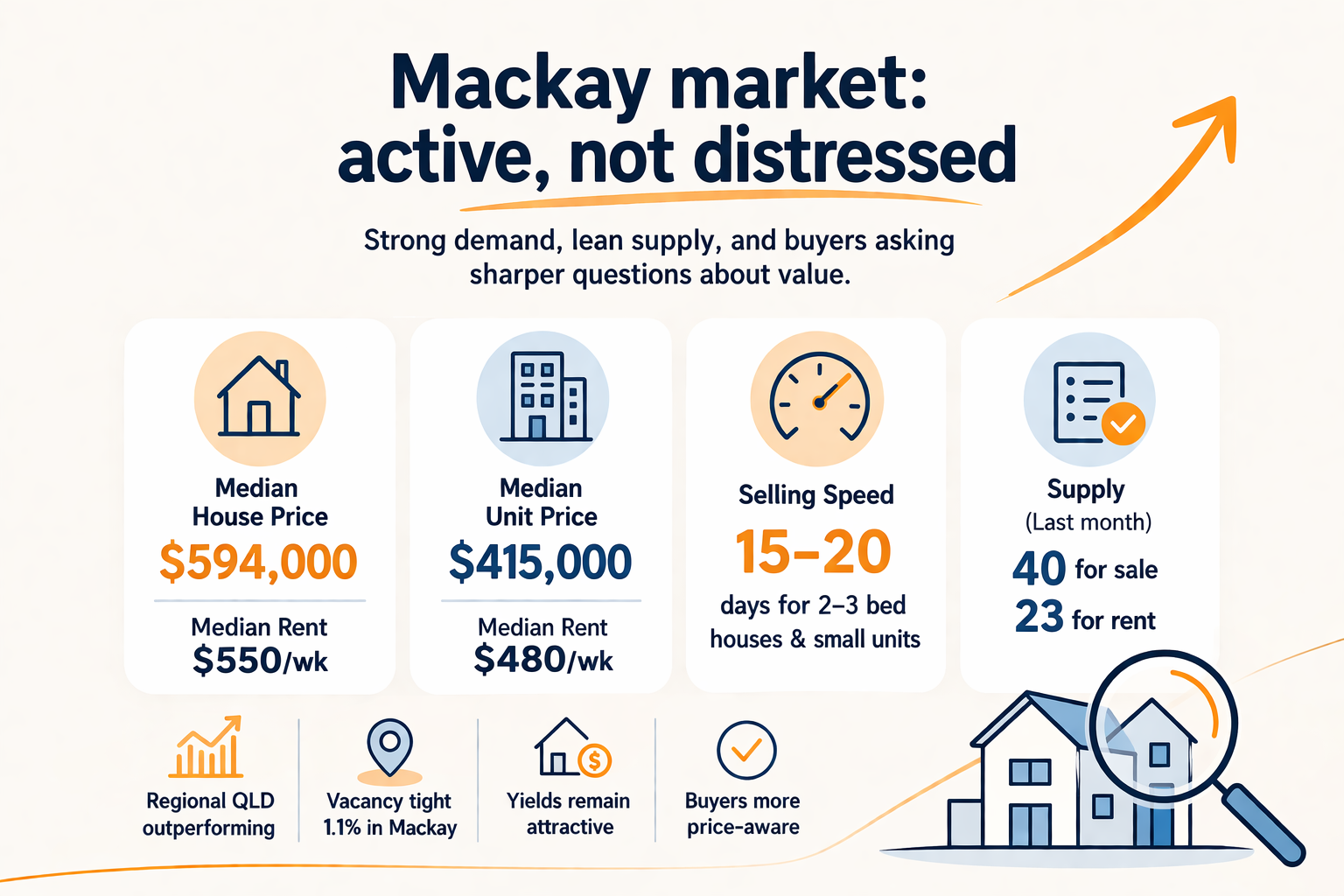
Mackay Market Holds Firm as Buyers Refocus
In Mackay, the market still feels more active than distressed, but the conversation is changing. Buyers remain engaged, yet they are asking harder questions about value, repayments, and holdin